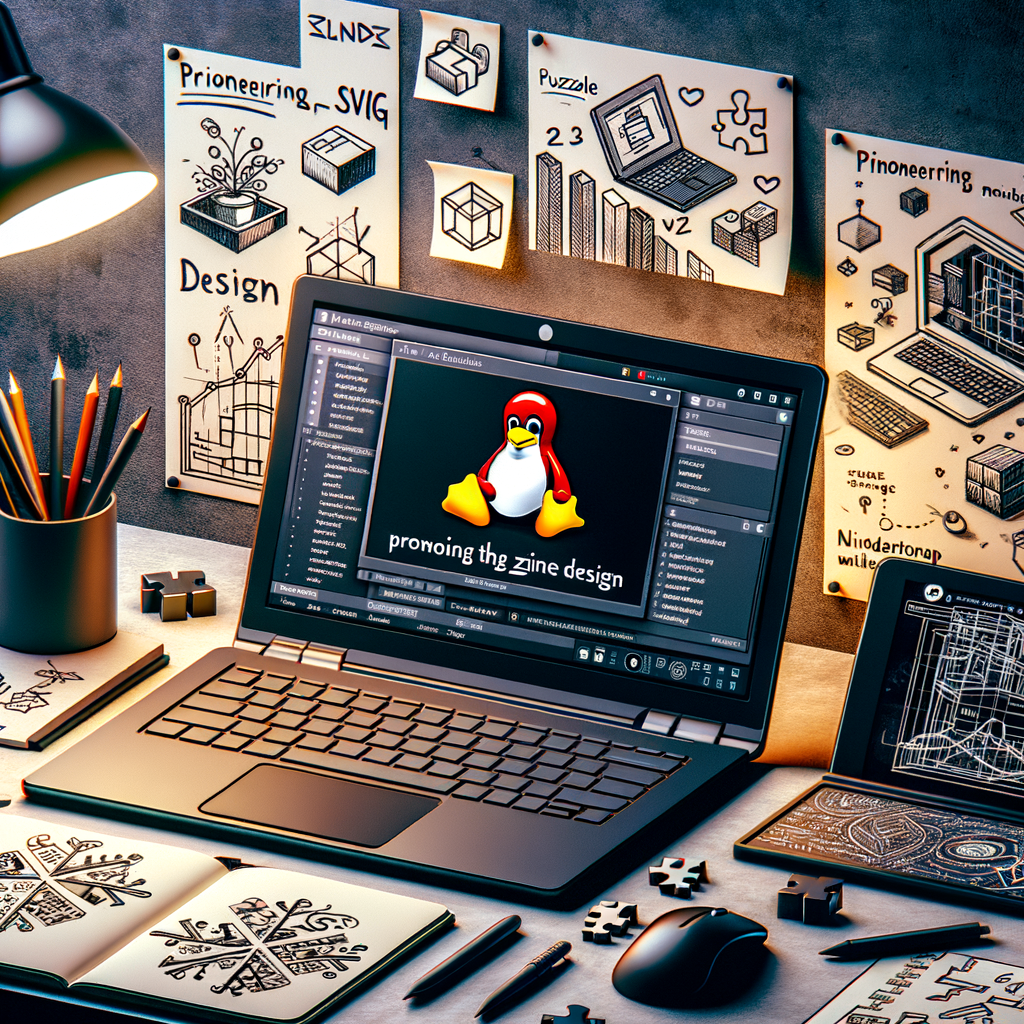
Inventive Approaches Shape Today’s Design Landscape: Zine Hacks, Puzzle Epics, and SVG Simplicity
Today in the world of design, innovation emerged from unexpected corners. From the unconventional production of the 404 Media zine to the ambitious, decade-long puzzle project by Jonathan Blow, and a deep dive into the power of SVGs, designers are revisiting old tools and principles to push creative boundaries. These stories illustrate how a blend of resourcefulness, persistence, and foundational knowledge continues to drive progress in design.
What Happened
Unorthodox Zine-Making with Linux and WINE
The team behind the 404 Media zine shared a unique lesson in adaptability. Eschewing standard publishing setups, they laid out their print zine on a Linux machine, using Affinity Publisher—software designed for Windows. The twist: Affinity ran via WINE, a compatibility layer that enables Windows applications to operate on Linux. This method is unconventional and technically challenging, but it worked, allowing the designers to leverage their preferred tools in a non-native environment. Their process highlights both the flexibility and the friction that come with customizing workflows outside the industry norm.
Jonathan Blow’s Puzzle Design Marathon
Game designer Jonathan Blow, known for works like Braid and The Witness, gave a preview of his latest project, Order of the Sinking Star. Over the past decade, Blow has meticulously constructed more than 1,400 puzzles for this game. What began as a modest idea evolved into a “combinatoric explosion,” with puzzle complexity multiplying as new mechanics were layered in. Blow’s approach is characterized by deep systems thinking and a willingness to invest years in refining every detail, reflecting a philosophy that values depth and discovery over quick iteration.
SVGs: The Minimalist’s Design Power Tool
Another article explored the enduring power of SVG (Scalable Vector Graphics) files. In an era with increasingly complex design tools and asset pipelines, the piece made the case that for many digital projects, “an SVG is all you need.” SVGs offer scalability, lightweight performance, and broad compatibility, allowing designers to create crisp, resolution-independent graphics with minimal overhead. The article suggests that, despite the allure of new technology, sometimes the simplest solution remains the most effective.
Why It Matters
These developments underscore a broader trend in design: the willingness to revisit and repurpose existing tools, methodologies, and philosophies. The 404 Media zine story is a testament to technical resilience—demonstrating how open-source and cross-platform experimentation can yield professional results outside the comfort zone of mainstream workflows. Jonathan Blow’s ongoing project highlights the value of patience and iterative design, serving as a counterpoint to the fast-paced cycles that dominate much of the industry. The focus on SVGs reminds digital creators that efficiency and clarity are often best achieved through simplicity rather than complexity.
Collectively, these stories suggest that innovation in design is not solely about adopting the latest technology. Instead, it is often about adapting to constraints, embracing depth, and leveraging foundational tools in creative ways.
Key Stats
- The 404 Media zine was laid out using Affinity Publisher via WINE on Linux—a rare setup in professional publishing.
- Jonathan Blow has designed over 1,400 puzzles for Order of the Sinking Star over the course of a decade.
- SVG files continue to offer scalable, high-performance graphics with minimal file sizes, supporting widespread browser compatibility.
- The “combinatoric explosion” in Blow’s project hints at exponential increases in design complexity as new mechanics are layered in.
What's Next
Looking ahead, the design community can expect to see more experimentation with unconventional workflows, particularly as open-source and cross-platform tools mature. Projects like Order of the Sinking Star may inspire more designers to invest deeply in systems-driven creativity, while the resurgence of interest in SVGs could lead to a renewed focus on accessible, performant web graphics. Ultimately, today’s developments point toward a future where adaptability, patience, and simplicity remain as crucial to design innovation as any new technology.