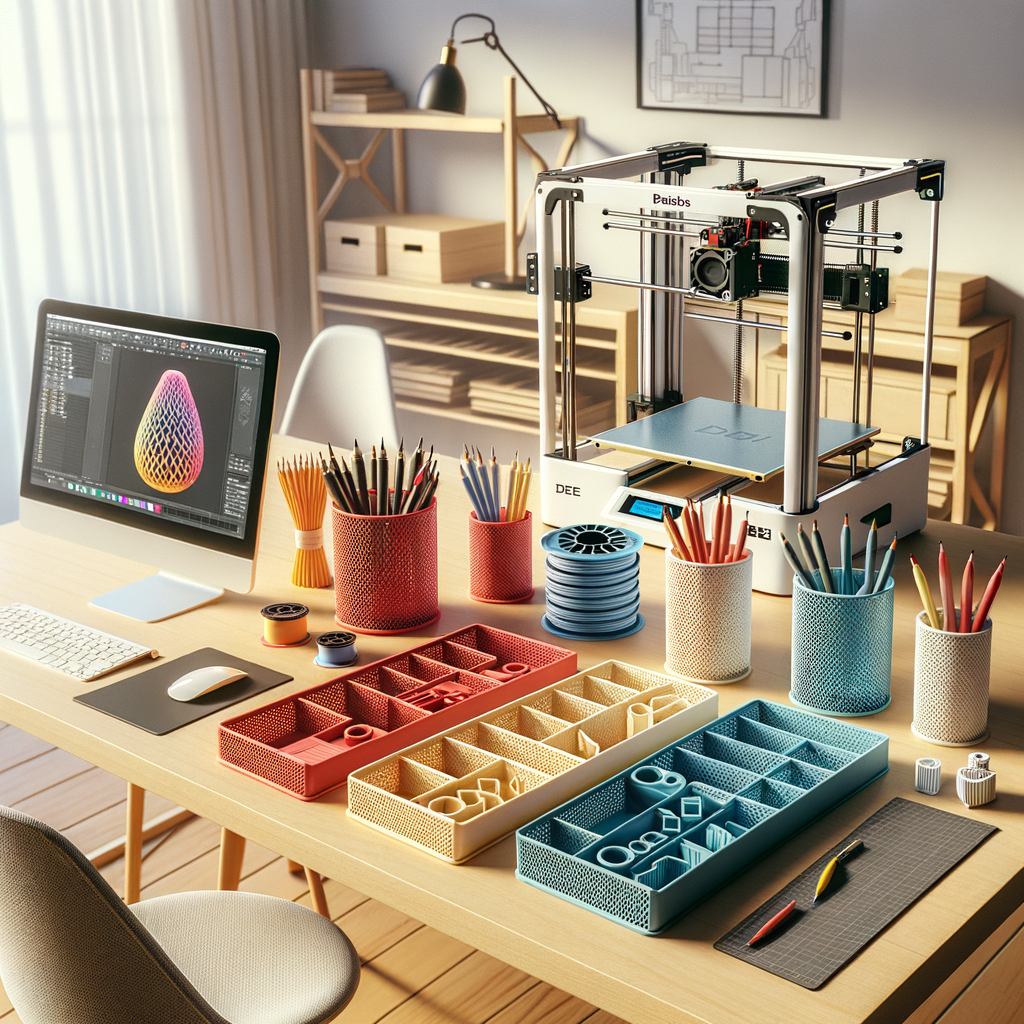
3D Printing Desk Organizers: Saving Money and Customizing Your Workspace
Today in the world of design, a fresh perspective on workspace organization emerged, demonstrating how personal fabrication technologies like 3D printing can empower individuals to create practical solutions while saving money. A firsthand account reveals not only cost savings but also the power of customization, as one designer opted to 3D print a set of desk organizers rather than purchasing them from a retail store.
What Happened
The central development centers on an experiment in workspace organization: instead of purchasing desk organizers from a store, a designer decided to 3D print their own. The project began with a search for desk organizers that met both functional and aesthetic needs. Finding commercial options lacking in either price or customization, the designer turned to 3D printing as an alternative.
Using freely available or low-cost 3D models from online repositories, the designer selected and modified designs to fit specific requirements—such as pen holders, cable organizers, and drawer trays. By leveraging their home 3D printer and inexpensive filament, the entire set was produced over the course of a few days. Notably, the designer was able to choose colors that complemented their workspace, a level of personalization not typically available with off-the-shelf products.
The final cost of materials came to approximately $10, compared to $70 for a similar set of organizers from a popular office supply retailer. Beyond cost savings, the designer highlighted the value of customizing the size and color of each item, resulting in a workspace that feels uniquely tailored to their needs.
Why It Matters
This development underscores a broader shift in how individuals approach design and consumption. 3D printing is increasingly accessible, and as this account demonstrates, it can deliver substantial savings and personalization for everyday items. By sidestepping mass-produced products, users gain more control over their environments, potentially reducing waste and fostering creativity.
From a design industry perspective, this trend raises questions about the future of consumer goods. If more people adopt hobbyist fabrication, demand for customizable, downloadable designs may grow, affecting manufacturers and retailers. Additionally, the ability to iterate rapidly on prototypes at home could influence how designers and consumers interact, blurring the lines between creator and user.
Key Stats
- The total material cost for 3D printing the organizers was approximately $10, compared to $70 for a retail set—a savings of $60.
- The printing process took about 12 hours in total, spread over several days.
- Online repositories offer thousands of free or low-cost 3D models for desk organizers, with search volumes steadily increasing.
- Home 3D printers compatible with these projects now start at under $200, making the technology more accessible than ever.
What's Next
As 3D printing technology continues to evolve, more consumers are likely to experiment with creating their own functional items, from desk organizers to household tools. This could drive further growth in online design communities and marketplaces for digital models. Manufacturers may respond by offering more customizable products or integrating digital fabrication into their business models. For designers, the boundary between professional and hobbyist work will likely continue to blur, with new opportunities for collaboration and innovation.