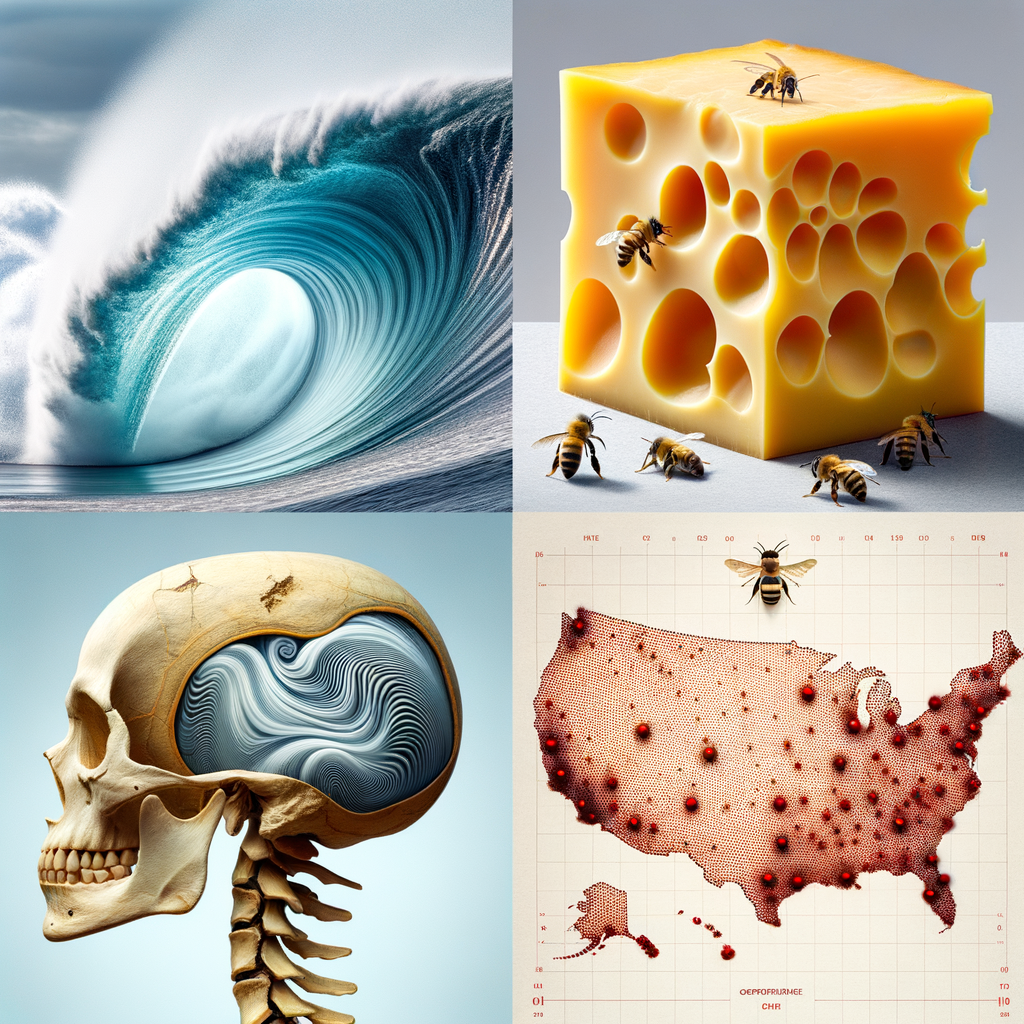
From Ocean Glitches to Cheddar Benefits: Today’s Breakthroughs in Science & Health
Today’s Science & Health news brings a remarkable blend of discoveries, from the mysteries of ocean dynamics to fresh insights on brain health, pollution mapping, and ancient bees. Each story offers a new piece to the complex puzzle of how we understand our world and our bodies.
What Happened
Nature’s Enigmas: Ocean ‘Glitch’ and Fossilized Bee Nests
Australian surfers and scientists witnessed what they describe as a real-life ocean ‘glitch’ off the coast—an extraordinary convergence of waves that swirled together and then erupted into a 130-foot pillar of saltwater. This repeating phenomenon remains unexplained, challenging current understanding of wave dynamics and coastal physics.
Meanwhile, paleontologists have discovered fossilized bee nests inside the skeletal remains of ancient mammals. These burrowing bees, using bones as nesting sites, represent an unprecedented ecological interaction. The find adds a novel chapter to the story of life’s adaptability and the complexity of prehistoric ecosystems.
Food & Brain Health: The Cheddar Connection
Researchers in Sweden have found that consuming high-fat cheeses, particularly cheddar, may be linked to a lower risk of dementia. The study suggests that cheese could be a beneficial part of a brain-healthy diet, with potential implications for dietary guidelines in aging populations.
Data Transparency: U.S. Carbon Polluters Mapped
A new initiative has produced a highly granular map detailing the dirtiest carbon polluters in the United States. This project, driven by the principle that “U.S. taxpayers have a right to this data,” provides unmatched precision in public access to emissions data, potentially influencing policy and accountability.
Statistical Debates: The Role of p-values
In a recent commentary, Vilgot challenges the application of Lindley’s paradox to the concept of “p-circling,” arguing that p-values should not be ascribed roles for which they weren’t intended. The piece adds to ongoing debates in scientific methodology over the use and misuse of statistical significance.
Why It Matters
These developments each shine a light on critical aspects of science and health. The ocean ‘glitch’ underscores how much remains unknown about natural phenomena, urging further research in marine physics. The discovery of bees nesting in fossils expands our understanding of historical ecological interactions and adaptation.
The Swedish cheese study could influence public health messaging around diet and cognitive decline. With dementia rates climbing globally, insights into preventive strategies are urgently needed. The U.S. carbon pollution map exemplifies the growing demand for transparency and data-driven environmental policy. Finally, the debate over statistical methods highlights the importance of rigor and clarity in scientific research—a foundation for credible discovery.
Key Stats
- The Australian ocean ‘glitch’ culminated in a 130-foot (approximately 40 meters) pillar of saltwater.
- Swedish research links high-fat cheese consumption with a reduced risk of dementia among adults aged 60 and over.
- The new emissions map provides block-by-block details of America’s highest carbon polluters.
- Fossilized bee nests were found inside the skeletons of mammals dating back millions of years.
- The debate over p-values and Lindley’s paradox continues to influence best practices in statistical reporting and research design.
What's Next
Researchers are expected to further investigate the mechanisms behind the ocean ‘glitch,’ potentially using advanced sensors and modeling. The implications of cheese consumption for dementia prevention will likely prompt larger clinical trials and dietary studies. Environmental advocates and policymakers may leverage the new emissions data to push for targeted interventions, while statisticians continue to refine best practices for scientific inference. Finally, paleontologists will explore whether bee nesting in fossils was more widespread than previously thought, opening new avenues in evolutionary biology.