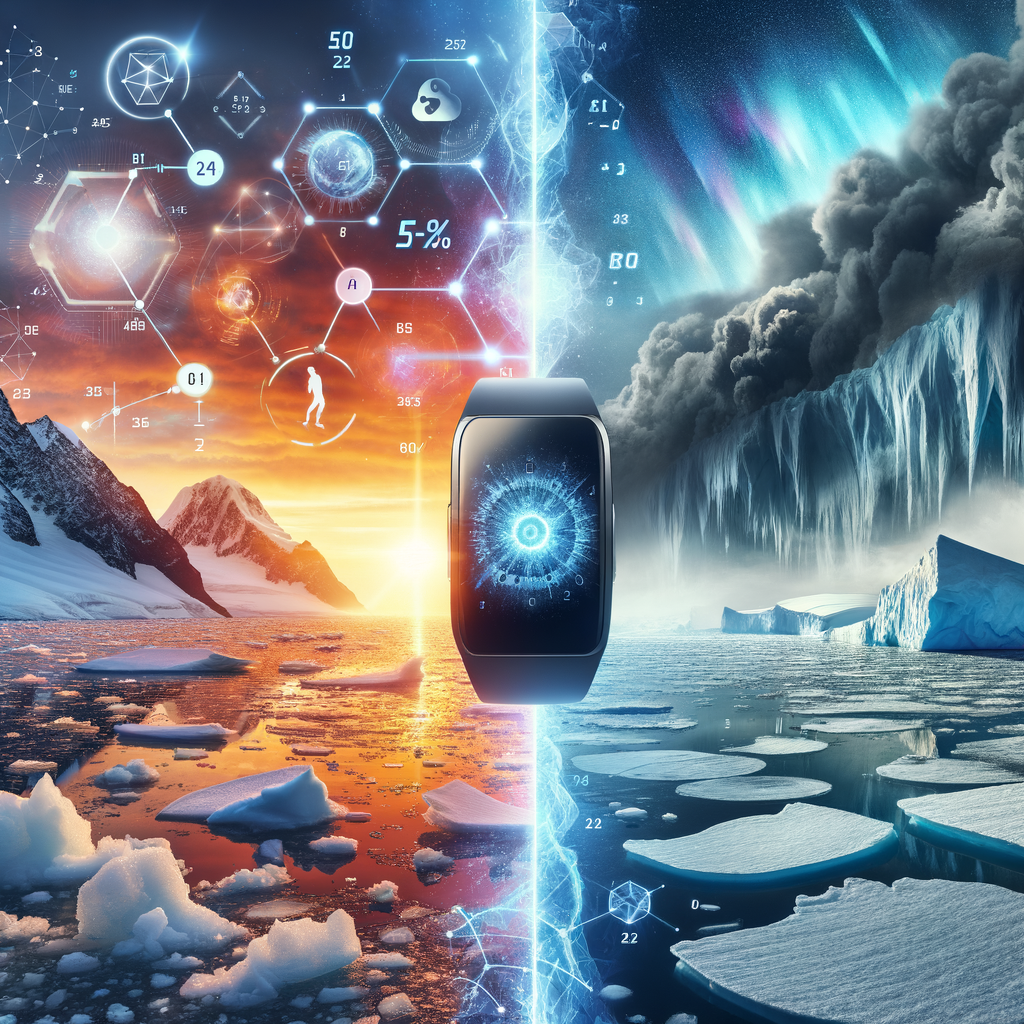
From Wearables to Wonders: Health Tech, Human Curiosity, and Antarctic Change
Today in science and health, major tech players are reshaping digital wellness, mathematicians are probing the boundaries of human imagination, and Antarctic researchers are uncovering the complex drivers of sea ice loss. These developments highlight how innovation, inquiry, and environmental change are intertwined in today’s world.
What Happened
Wearable Health Tech Raises the Bar
Google has unveiled the Fitbit Air, a $99 screenless wearable designed to streamline health tracking. Alongside this, Google introduced the $9.99 per month Gemini health coach, powered by its advanced AI models, promising personalized health insights and guidance. In response, Whoop—a leading fitness wearable company—rapidly announced the integration of on-demand video consultations with licensed clinicians. This new feature allows users to connect directly with healthcare professionals, offering a human complement to the digital guidance provided by AI.
Our Fascination with Enormous Numbers
Mathematician Richard Elwes delves into humanity’s enduring obsession with numbers that dwarf comprehension—so-called “ginormous” numbers. From ancient times through the digital age, people have been drawn to conceptualizing and naming numbers that are not just impractically large, but fundamentally unreachable. Elwes explores what this fascination reveals about human cognition and our drive to push the limits of understanding.
Antarctic Sea Ice: Compound Drivers of Loss
A new scientific report reveals that recent losses of Antarctic sea ice are not driven by a single cause. In East Antarctica, ocean upwelling has brought warmer waters to the surface, accelerating ice melt. In contrast, West Antarctica’s sea ice decline is linked to radiative flux anomalies—changes in how energy moves through the atmosphere and ocean. This regional complexity is also contributing to the destratification of the Southern Ocean, disrupting established layers of water temperature and salinity.
Why It Matters
The competition between Google and Whoop illustrates the rapid evolution of digital health—and the growing expectation for both AI-powered efficiency and human expertise in wellness management. As wearables become more affordable and intelligent, they may transform preventive care and patient engagement.
Humanity’s fascination with vast numbers is not just a mathematical curiosity. It reflects our innate drive to explore the unknown, test cognitive boundaries, and develop the language needed to describe the unimaginable. This pursuit not only advances mathematics but also shapes how we think about scientific and technological frontiers.
Antarctic sea ice loss is a bellwether for broader environmental change. Understanding the compound, region-specific drivers is critical for improving climate models and predicting global impacts, from sea level rise to changes in ocean circulation. The findings underscore that climate change effects are rarely the result of a single factor, and that nuanced approaches are needed for mitigation and adaptation.
Key Stats
- Fitbit Air launches at $99 with a $9.99/month Gemini AI health coach subscription.
- Whoop adds on-demand video consultations with licensed clinicians, marking a first for mainstream fitness wearables.
- Recent Antarctic sea ice loss is driven by ocean upwelling in East Antarctica and radiative flux anomalies in West Antarctica.
- Richard Elwes highlights the exponential growth of named large numbers, from “googol” (10^100) to numbers with millions of digits.
What's Next
The integration of AI and licensed clinicians in health wearables could signal a broader shift toward hybrid wellness ecosystems, blending automated insights with human care. As competition intensifies, expect more personalized and holistic offerings in consumer health tech.
In mathematics, the quest to define ever-larger numbers will likely continue, inspiring new ways to communicate and conceptualize the infinite. This tradition may also inform advances in computing, cryptography, and data science.
For Antarctica, research will focus on refining climate models to account for the interacting drivers of sea ice loss. Improved understanding is critical for anticipating future changes in the Southern Ocean and their global repercussions, particularly as the climate crisis accelerates.