Robots, Record Heat, and Ozone Surprises: Today’s Science & Health Highlights
Today in Science & Health, the headlines ranged from ambitious investments in educational technology to urgent warnings over record-breaking heatwaves sweeping Europe. New research is challenging decades-old assumptions about the ozone layer, while historic innovations in assistive technology for non-speaking children remind us how far we've come—and how much we still have to learn.
What Happened
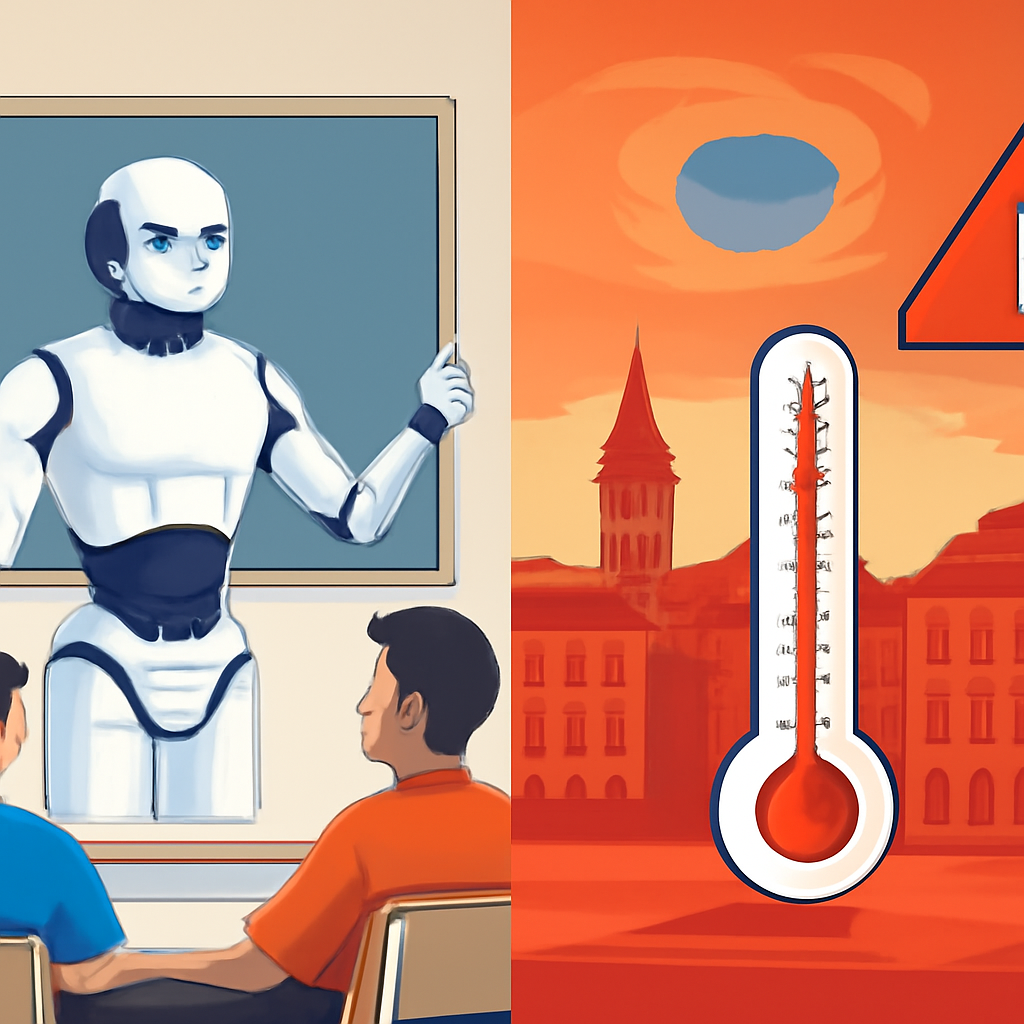
High-Tech in the Classroom: San Diego’s $500,000 Humanoid Robots
A San Diego charter school has drawn attention for allocating $500,000 to purchase two humanoid robots. The goal is to integrate cutting-edge robotics technology into the classroom, promoting STEM education and offering students hands-on experience with advanced AI. However, questions have arisen about the educational value of such a hefty investment, with critics likening the robots’ current functionality to little more than a “bad Nikola Tesla impersonation.”
Europe’s Heatwave Crisis: Alarming Death Toll in Italy
Southern Europe is enduring a brutal heatwave, with Italy at the epicenter. Today, 25 Italian cities were placed under a red alert due to extreme temperatures. Health authorities are sounding the alarm as the death toll mounts, with estimates suggesting that more than 10,000 people across Europe may have died due to heat-related complications between June and July. The relentless heat is not only a public health emergency but also a stark reminder of the growing impact of climate change.
The Ozone Hole: Rethinking the Cause
A new study is rewriting the narrative on the origins of the Antarctic ozone hole. While chlorofluorocarbons (CFCs) have long been blamed for most of the damage, researchers now argue that if scientists in the 1950s and 1960s had had today’s atmospheric monitoring tools, they might have detected the hole decades earlier. This suggests that additional, earlier factors may have contributed to ozone depletion, challenging our understanding of environmental history and policy.
Revisiting Early Computer-Aided Language Development
A historic study from 1968, recently highlighted by the Internet Archive, explored the use of computer-aided tools to assist non-speaking children in language development. The research, published in the Archives of General Psychiatry, set the groundwork for decades of technological advances in augmentative and alternative communication (AAC) devices, emphasizing the long-standing intersection of technology and health care.
Why It Matters
The decision by a San Diego school to spend $500,000 on humanoid robots reflects the broader debate about the role and cost-effectiveness of AI in education. As schools face tight budgets, the push for high-tech solutions must be weighed against proven, lower-cost interventions.
Meanwhile, Europe’s intensifying heatwaves are a harbinger of global climate risk, with thousands of lives already lost. The mounting death toll underscores the urgency for robust adaptation strategies and highlights vulnerabilities in public health systems.
The ozone hole’s revised origin story is more than a historical footnote; it challenges our models of atmospheric science and could inform future environmental policy and monitoring. Finally, the revisiting of early computer-assisted language work for non-speaking children is a reminder that today’s tech-driven health solutions often stand on decades of foundational research.
Key Stats
- $500,000: Amount spent by a San Diego charter school on two humanoid robots for educational purposes.
- 25: Number of Italian cities under red alert for extreme heat on June 30, 2026.
- 10,000: Estimated number of heat-related deaths in Europe between June and July 2026.
- 1985: Year the ozone hole was discovered; new research suggests it could have been detected 30 years earlier with today’s technology.
- 1968: Year early computer-aided language development for non-speaking children was documented in psychiatric literature.
What's Next
The scrutiny over high-cost educational technology is likely to intensify, prompting more rigorous evaluation of learning outcomes versus investment. Europe’s response to heatwaves will test public health infrastructure and could spur new climate adaptation policies. As ozone research evolves, expect further debate about the interplay of human activity and atmospheric chemistry. And as we reflect on decades-old breakthroughs in assistive tech, there’s an opportunity to accelerate development and ensure wider access for children who need it most.