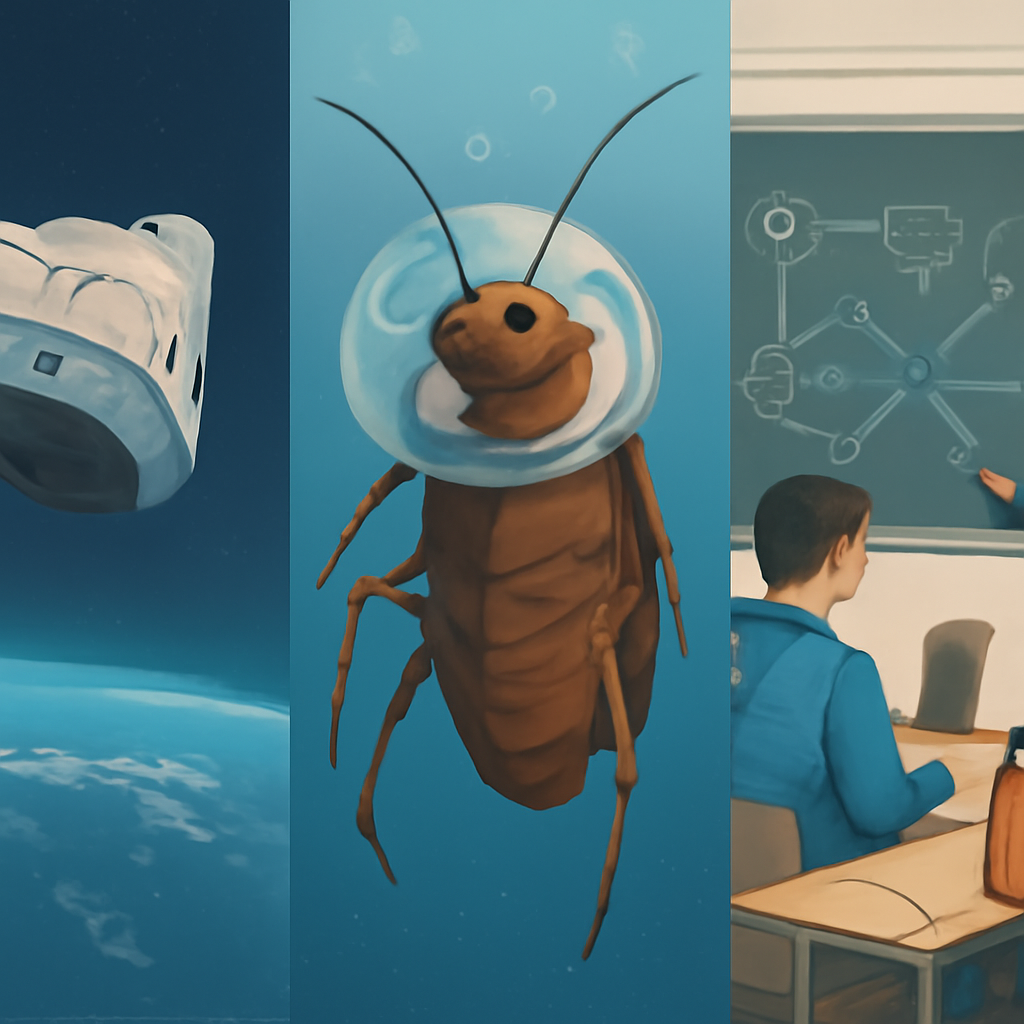
Swift Saves, Cyborg Cockroaches, and Category Theory: Today's Breakthroughs in Science & Health
Today's Science & Health news highlights the interplay between urgent problem-solving, groundbreaking bioengineering, and educational innovation. NASA's rapid response to an orbital threat, a creative experiment with robotic insects, and an academic push into advanced mathematics reflect the diversity and ambition driving research and action in 2026.
What Happened
NASA's Emergency Mission to Save Swift Observatory
In a demonstration of technical agility and international coordination, NASA launched an emergency mission to prevent the Swift Observatory—a key space telescope—from an uncontrolled descent toward Earth. The mission was assembled in a remarkable nine months, a timeline far shorter than typical for such complex spacecraft operations. The Swift Observatory, vital for monitoring gamma-ray bursts and other high-energy cosmic events, had experienced a systems failure that threatened its stability and safety in orbit. The emergency intervention aims to either reboost the observatory or enable a controlled deorbit, minimizing risk to populated areas and preserving scientific assets.
Cyborg Cockroaches Take the Plunge
Researchers have created a 3D-printed scuba suit for cyborg cockroaches, enabling these modified insects to survive underwater for up to three hours. The cockroaches are equipped with tiny electrodes, allowing for remote control and data collection. This experiment showcases the increasing sophistication of biohybrid robotics and opens up new possibilities for deploying small, resilient creatures in environments previously inaccessible to biological or traditional robotic systems—such as submerged disaster zones or hazardous underwater sites.
Applied Category Theory Course Launches
In academic news, a new course in Applied Category Theory has been announced, responding to the growing demand for mathematical frameworks that unify concepts across disciplines. While details are limited, the course is expected to attract students and researchers from computer science, physics, and engineering, reflecting category theory's expanding influence in modern science and technology.
Why It Matters
NASA's swift action highlights the importance of both rapid engineering response and international collaboration in safeguarding critical infrastructure in space. The mission's expedited timeline could set a precedent for future emergency responses to threats from aging or malfunctioning satellites.
The cyborg cockroach project demonstrates the convergence of biology, robotics, and materials science. Building underwater-capable biohybrid robots could revolutionize search-and-rescue, environmental monitoring, and even precision agriculture, leveraging the natural abilities of insects enhanced with human-designed technology.
The launch of an Applied Category Theory course signals a shift in STEM education, as more fields seek the unifying power of abstract mathematics to tackle complex, interdisciplinary problems. This may accelerate innovation across physics, computing, and engineering.
Key Stats
- NASA assembled the Swift Observatory rescue mission in just 9 months, significantly faster than typical spacecraft missions.
- The Swift Observatory is essential for monitoring gamma-ray bursts and high-energy cosmic phenomena.
- Cyborg cockroaches equipped with 3D-printed scuba suits survived underwater for up to 3 hours.
- The cyborg cockroaches were fitted with electrodes for remote control and data collection.
- A new Applied Category Theory course is launching, targeting students across multiple STEM disciplines.
What's Next
NASA's mission will serve as a case study for rapid response operations in space, and its outcome will inform future policy and engineering protocols for satellite emergencies. The success of the cyborg cockroach experiment may lead to expanded research into biohybrid robotics, potentially resulting in autonomous insect-based systems for complex tasks in extreme environments. The Applied Category Theory course is likely the first of many, as demand grows for cross-disciplinary tools that can bridge gaps between diverse scientific domains.