Europe Launches, Ocean Worlds Beckon, and a Math Milestone: Science & Health Recap
What Happened
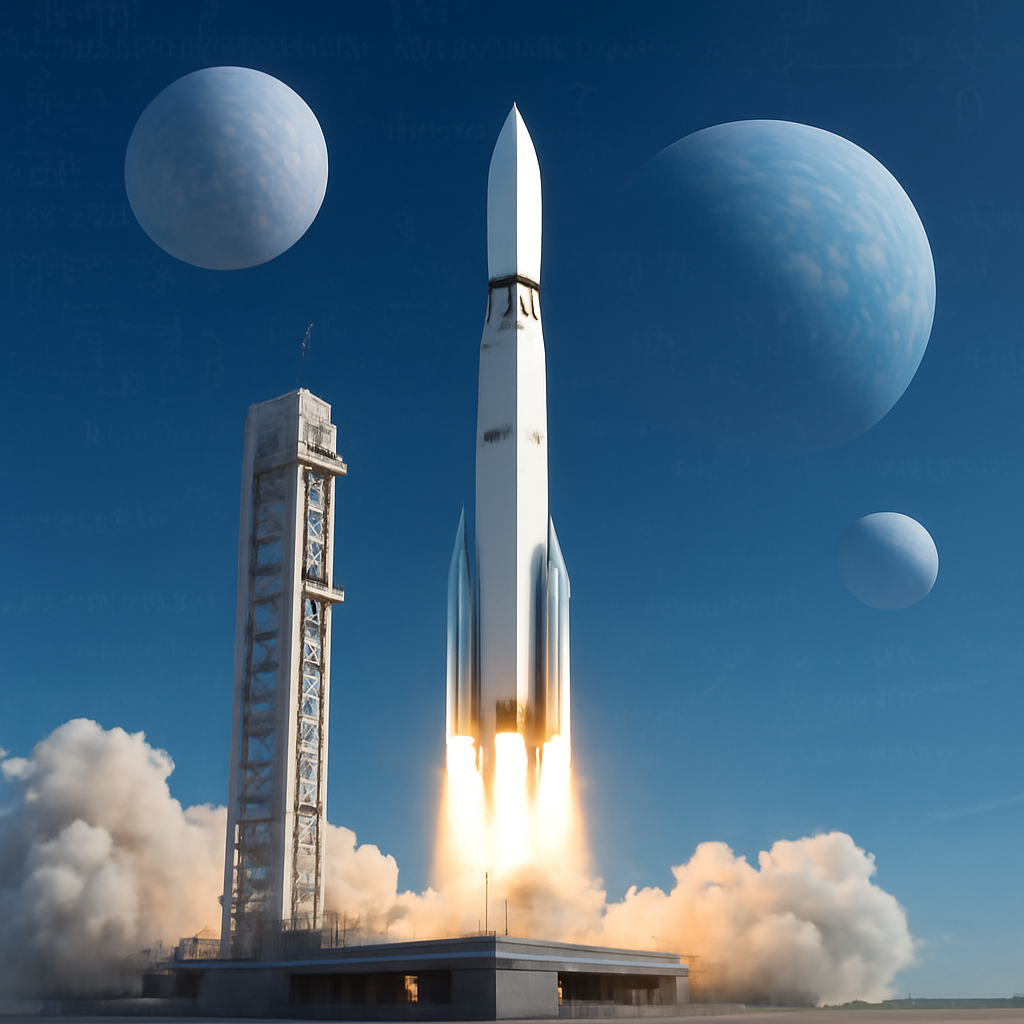
Three notable developments shaped science and health news today. First, Isar Aerospace successfully launched Europe’s first commercial orbital rocket, offering the continent a homegrown alternative for space access. Second, new research highlighted the promise of icy moons in our solar system—such as Europa and Enceladus—as “ocean worlds,” possibly harboring subsurface seas. Finally, a mathematician posted a significant paper to arXiv, presenting evidence for finite time blowup in an averaged version of the three-dimensional Navier-Stokes equation, a long-standing mathematical challenge.
Why It Matters
Europe’s entry into commercial orbital launches reduces reliance on non-European providers, marking a strategic and economic milestone for the continent’s space sector. The identification of icy moons as potential ocean worlds reignites interest in planetary science and astrobiology, as these environments may support life. Meanwhile, progress on the Navier-Stokes equation addresses a fundamental problem in fluid dynamics, with implications for physics, engineering, and mathematical theory.
Key Stats
- Isar Aerospace’s launch marks the first time a European private company has reached orbit commercially.
- Over a dozen icy moons in the solar system are now considered likely to contain subsurface oceans.
- The Navier-Stokes equations, central to fluid mechanics, have resisted proof of smoothness or blowup for over a century.
- The new mathematical paper is under review by the Journal of the American Mathematical Society.
What's Next
Isar Aerospace’s achievement may catalyze further investment and innovation in Europe’s space sector, potentially leading to more frequent and independent launches. Upcoming missions may target icy moons for direct study of their oceans, seeking evidence of life or unique chemistry. The mathematical community will scrutinize the new Navier-Stokes result, which could influence future research in both theoretical and applied fluid dynamics.